We love —
- A tropical getaway that mixes both a city adventure and relaxing beachside stay.
- The excursions included in the programme including a visit to a cigar factory, a rum factory and the Fundacion Havana Club.
- Staying in a unique homestay in Havana as well as a 5* hotel on the beach in Varadero with All Inclusive dining included.
New Voyage Privé —
Carefully selected for our members by our experts
Your Itinerary In Brief —
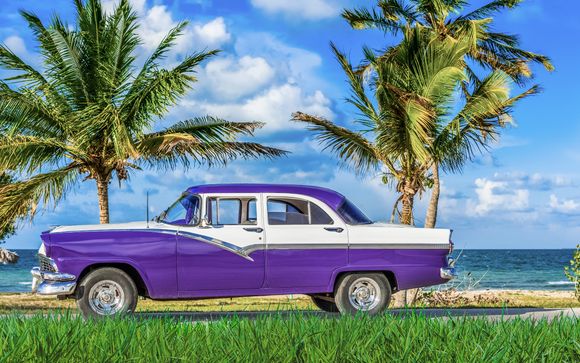
Book a holiday that perfectly combines city and beach in colourful Cuba! This 8-night private tour takes you from the hectic pace of the capital, Havana, to the greenery of the Viñales Valley and the tranquil beaches of Varadero.
Your itinerary:
Day 1: Arrival in Havana
Day 2: Havana
Day 3: Havana - Viñales
Day 4: Havana - Varadero
Day 5 - 8: Beach stay in Varadero
Day 9: Departure from home
Please note that the order of the activities can be changed without affecting the interest of the programme.
Your Itinerary In Detail —
Day 1: Havana
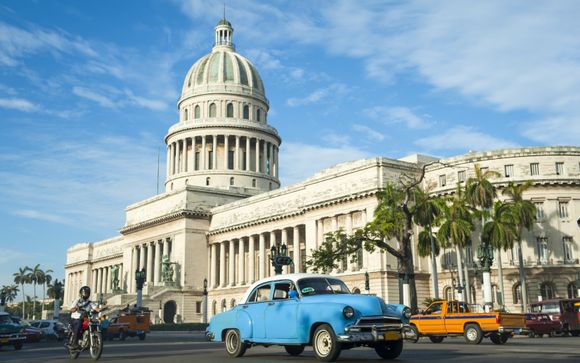
Flight to Cuba. Arrival in Havana. Luggage collection and customs formalities.
Welcome in the airport lobby by your English-speaking guide. Private transfer to your hotel. Arrival at the hotel and check in.
New hotel regulations in Cuba today: each participant's passport must be handed in at this time for the reception staff to scan before returning it to you that evening or the next morning. This will be repeated on arrival at each of the hotels on your tour.
Settle into your room.
You have a free evening - dinner not included.
Havana: founded in 1519 by the Spanish, Havana became a major shipbuilding centre for the Caribbean in the 17th century. Although today it is a sprawling metropolis of two million inhabitants, its old centre retains a priceless mix of Baroque and neoclassical monuments, as well as a homogeneous set of houses with arcades, balconies, wrought iron railings and courtyards. Havana is in the process of being restored, struggling to cope with the many hardships it has faced through the years, however it is beautiful and bubbling with life.
This portrait of the city takes the 1950s as its starting point, with occasional glimpses back to the first decades of the century. It opens with the years when the people built casinos, hotels and nightclubs, the years when Havana became the playground of the rich and famous. Visitors in those years revelled in the rhythms and music they had come to encounter. But the "Habaneros" themselves, the people of Havana, have always been alert to the latest trends and long ago gained a reputation for inventiveness and vivacity. Today, Havana retains its unique charm which comes from the mix of cultures that make it up, from the sensual exuberance of the Caribbean to the ever alert search for new American and European fashions.
Accommodation: Superior homestay
Board and lodging: Bed & Breakfast
Transfers: Havana airport to accommodation
Distance and travel time: 35 min (25 Km)
Day 2 - Havana
Breakfast at the casa: "La Habana Vieja".
This is the heart of the city, surrounded by ancient walls, which was declared a World Heritage Site by UNESCO in 1982 and is the largest colonial city centre in Latin America.
For four centuries, the Spanish ruled Cuba before the island gained its independence in 1899 and the United States took over through dictators like Batista. It is therefore logical that Ibero-Andalusian influences are omnipresent in the architecture.
Today, the city is in the process of being restored.
Board: Half-board
Visit to a cigar factory - Minimum age requirement: 17 years
- Closed on Saturdays and Sundays, on public holidays and at the end of the year (generally from 15-20 December to 20 January), as well as part of July and August (for Calle 0 e/1ra y 3ra, La Habana Cuba | [email protected] | T: +53 5 2963333 www.cubarama.net the summer holidays, generally between 14 July and 15 August...). The cigar factories now close around 12:00 each day, so it is imperative to visit the factory in the morning.
Discovery of Historic Old Havana. The visit is done on foot in the heart of the typical streets.
- Plaza de la Catedral - This is one of the most beautiful squares in the city, the most famous anyway. It is also the most harmonious. It is considered to be the best preserved colonial architectural ensemble in Latin America. The paving is arranged in such a way as to form a cross in the centre. Musicians play in the café to the left of the cathedral. A plaque recalls the visit of Pope John Paul II to Havana in January 1998.
- The first documents, at the end of the 16th century, mention the square as Plaza de la Cienaga (Marsh Square), due to the waters that, in the rainy season, transformed it into a pond. In 1592, a freshwater tank was built in the Callejón del Chorro (Water Fountain Lane) to supply ships. The marsh was drained in the 17th century and, at the beginning of the 18th century, the construction of some of the buildings that we see there today began. At the end of the 18th century, the former Jesuit church was consecrated as a cathedral and the square took on its current name.
- Calle Empedrado, which leads to the famous Bodeguita del Medio, dear to Hemingway's heart, where he liked to enjoy his mojito.
- Calle Obispo, the liveliest street in the old town, with the Ambos Mundos (Two Worlds) hotel, where Hemingway stayed when he was in the Cuban capital.
- The Palacio del Marques de Arcos, transformed into a central post office in the 19th century. A stone mask still swallows the mail.
Board: Half board
The Plaza de Armas - It all started here. In 1582, all the hovels were pulled down. According to an excerpt from a Cabildo document dated 25 February 1559: "An order was given to draw a square for this city, because the fortress - Castillo de la Real Fuerza - that is being built here, occupies the space of the old square." The Plaza de Armas, previously known as the Plaza de la Iglesia (Church Square), houses the city's first parish church. In addition to its religious symbolism, it is also the site of political and military institutions. After the demolition of the church in 1776, the square took on its current dimensions. In the 19th century, the captain-general gave grand parties here, and the nobility rode in carriages. From restoration to restoration, the current square, rebuilt according to the engravings of the time, has recovered its 1841 appearance: only the statue of Ferdinand VII has been replaced by that of Carlos Manuel de Céspedes.
- The Plaza de Armas is surrounded by splendid colonial buildings, such as: ✓ The Palacio de los Capitanes Generales (Palace of the Captains General), which houses the city's museum (interior visit not included) (closed on Mondays) (attention: fee to be paid on site to photograph) ✓ El Templete (the Temple) and its famous Ceiba tree, around which every 16th of November Cubans come in procession to make a wish and place an offering, ✓ The Palacio del Segundo Cabo, ✓ The Castillo de la Real Fuerza which houses a maritime museum.
- Plaza San Francisco de Asis - This is the second-largest square in the city. Its origins date back to the second half of the 16th century. It owes its name to the church and convent of St. Francis of Assisi, built at the end of that century. The square is located opposite the harbour quays and is an important commercial centre. The crews of the royal fleet would refuel here, drop off goods and spend some time here before continuing their journey. The first houses of the governor, the Cabildo, the archives (transferred to the Plaza de Armas in 1792) and the first prison were built in this square. Until the middle of the last century, it was also here that the Saint Francis celebrations took place on 4th October, accompanied by various games.
- The Plaza Vieja - built in 1559 after the Plaza de Armas, which was intended for the military at the time, it quickly became the heart of the city. The first attempt at urban planning in the history of post-Columbian America, its layout innovates in relation to the Spanish urban organisation with the integration of private residences. Today, completely renovated, it is still one of the most popular places for visitors.
Lunch during the excursion in a local restaurant (1 drink included per person: 1 mineral water or 1 soda or 1 local beer).
Visit to the Rum Museum or Fundación Havana Club: housed in an 18th century colonial house in the heart of Old Havana, it is first and foremost a museum that traces the history of rum in Cuba, exposes its various production processes and takes the visitor on a tour of an old rum factory.
It is also a place of relaxation and culture. There is, side by side, a shop, a bar open day and night, where the best musicians of the island perform, a conference room and an art gallery, which allows the promotion of local artists throughout the year.
Wine tasting at the end of the visit.
Return to the hotel for refreshments.
Accommodation: Superior homestay
Day 3: Havana - Viñales - Havana
Breakfast at the casa.
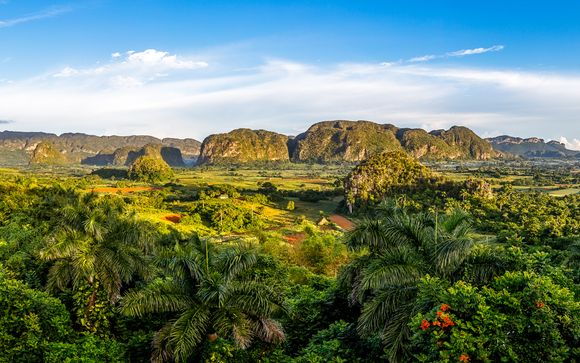
Departure for the Viñales Valley, which has been a UNESCO World Heritage Site since 1999. This is due to its unique hills and the charming pueblo of the same name. The Viñales Valley is the main attraction of the province. What will catch your attention most of all are the "Mogotes", the limestone mountains that have sprung up abruptly in this valley that stretches for almost 25 kilometres.
The formation of these mountains can be explained by the existence of a plateau (from about 160 million years ago) whose upper part collapsed and of which the "Mogotes" were the pillars. Walk through the Viñales valley to get a closer look at the particular beauty of the site.
On the Palmarito trail, you will discover the many natural treasures and the way they have been used by man. From the mogotes and their caves to the tobacco fields, from the coffee plantations to the pine forests, your walk will be very varied.
You will also be able to observe the diversity of birds in the region. But the main attraction of the walk is the observation of the mogotes, limestone formations or perpendicular walls that can reach 400 m high. The mogotes are surrounded by tobacco plantations and red clay soil.
It is a wonder of nature, a geological setting that is practically unique in the world, and surprising, to say the least, since it is found only in the Malacca Peninsula in Asia.
You will be able to meet a tobacco farmer and discover with him the drying room of selected tobacco leaves.
Stop at the Mirador Los Jazmines, a viewpoint from which you will discover a superb panorama of the Mogotes Valley. Lunch at the restaurant "Palenque de los Cimarrones" or similar.
Many fugitive slaves (called Cimarrones) found refuge in the caves of the Viñales region. In order to reach the restaurant, we will walk through a narrow cave illuminated by a "Mogote" (1 drink included per person: 1 mineral water or 1 soda or 1 local beer).
Visit to the Despalillo (closed on Saturdays and Sundays, and on public holidays).
The Despalillo's operation is called "écotage": once the broken leaves have been separated, the central vein is removed and the leaves are flattened. The leaves are then moistened and covered with a cloth, under which they are fermented again before undergoing a final sorting.
Fermentation evens out the tobacco's flavour somewhat, but more importantly reduces its acidity, tar and nicotine content, thus enhancing its taste.
The leaves can then be sent to the factories.
Continue to Finca Macondo, to discover its tobacco plantation and tobacco drying room with a cigar rolling demonstration (tasting if you wish).
Return to Havana in the late afternoon. Dinner is not included.
Accommodation: Superior category homestay
Board: Half board
Transfers: Havana to Viñales and back
Distance and travel time: 2 h 30 min (184 km) per trip
Day 4: Havana - Varadero
Breakfast at the "casa" then departure for Varadero by private transfer.
Accommodation: Hotel "Meliá Varadero 5*".
Board: All Inclusive in Varadero
Transfers: From Havana to Varadero
Distance and travel time: 2 hrs 35 min (159 km)
Days 5 to 9 - Beach stay in Varadero
You have these days free to relax, explore and do as you please!
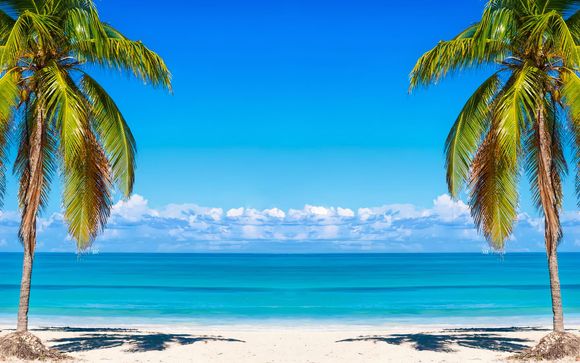
Varadero, an international seaside resort which offers all the most modern conveniences in order to end your tour with a well-deserved idleness at the edge of a magnificent white sand beach.
At the end of your stay, you will take a private transfer to the Havana airport.
Your Hotels —
HAND-PICKED JUST FOR YOU
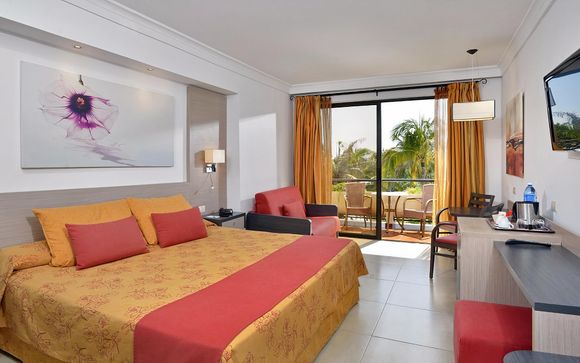
Delight in a truly unique trip by staying in both a hotel and in a home stay!
Your accommodation:
In Havana: Homestay (superior category) for 3 nights
In Varadero: Melia Varadero 5* Hotel for 5 nights
In case of unavailability of the hotels listed above, accommodation will be made in hotels of similar category.
The maximum capacity of the rooms is 3 adults or 1 adult + 2 children. Possibility to stay in a single room with supplemental charge.
Your Dining Choices
Your board basis will be as per itinerary (please see the details of your programme for more information).
Your Journey to Cuba —
Flights:
You may choose from Economy, Premium or Business class flights on sectors that they operate, at the next stage of the booking process. The flights included are with either a scheduled or no-frills airline and are subject to live availability and prices can change. You can choose your preferred departure times during the booking process. Please select your flight options carefully as departure and arrival airports may differ.
Your Destinations —
Havana

Offering a vibrant mix of cultures, history, and experiences, Havana attracts tourists with its lively cafés and bars, all playing the tantalising sounds of rumba. With its colourful architecture inspired by an eclectic mix of Baroque, neo-classical and Art-Deco styles, a stay in this Caribbean city is one you’ll never forget.
The UNESCO World Heritage Site of Old Havana is the beating heart of this lively city, where you’ll find authentic Cuban cuisine and bars serving the best Caribbean cocktails including daiquiris and mojitos. If you’re looking to discover Cuba’s eventful history, head to the Museo de la Revolución, housed in a former presidential palace. As the sun sets, experience the city’s vibrant nightlife at the iconic Tropicana Club, where you can catch a cabaret performance and sip a Cuba Libre cocktail.
Varadero

Varadero is the home of all inclusive, relaxation-focused resorts in Cuba. Nestled atop 20 km of Atlantic Ocean coastline, Varadero is pivotal to the success of Cuba's economy, and promises a year-round tropical climate, an expansive stretch of soft, white sand, and stunningly blue waters.
Holidays in Varadero should be all about sunshine, fresh mojitos, and long days bathing on the beach in a stress-free environment. However, for those who wish to keep active and explore further afield, this region of the country boasts its own set of cultural and historical attractions. Located less than one hour from the beach, the Bellamar Caves are Cuba's oldest tourist attraction, formed over 300,000 years ago and displaying an awe-inspiring selection of stalagmites to this day - why not head out in a classic car and discover for yourself?
